

In this three-part series of articles Sam Lloyd, Executive Director of CRO Corporate Services Limited, outlines the evolution of corporate information service provision during his career, including significant events, personal achievements and the influences that have shaped the industry.
COMPANIES HOUSE IN THE 1970’s
Who can believe it? I’ve been in the corporate information services provision industry for over 50 years! When I was a fresh-faced 13-year-old my sister, Mary (Lovell), managed to get me a casual job at Companies House in City Road, London EC1, during my school holidays, working for pocket money with her employer D&D Law Agency Services Limited (D&D), based in Lincoln’s Inn Fields.
My role was to look up company numbers. This would entail moving metal flipcharts from side to side to locate company names that were alphabetically placed in the carousels. When a company was registered with Companies House it would produce a thin sliver of card containing the company name and number. The sliver of card would then be manually inserted into the relevant flipchart. I often watched Companies House staff inserting companies into the flipcharts by moving the existing card entries up and down. I thought that this was an inefficient and laborious task that could surely be improved in some way or form. I was paid the princely sum of three pennies per number – that’s three pennies before decimalisation (12 pennies to the shilling and 20 shillings to the pound) and is the equivalent of 1.25 pence in today’s money.
As a progression over the next few years, I was trusted to cross the road to the Registry of Business Names (RBN), which contained hard-copy papers for all nonlimited businesses. There, I would locate business name entities and partnerships and transcribe the details from file entries onto a report template.
The Registry of Business Names was created under the Registration of Business Names Act 1916. It was initially intended as a record of enemy aliens or former aliens who were not trading under their own names, but later served as a register of persons or firms trading under a business name other than their own. Persons or bodies trading in their own names were not required to register. Under the Companies Act 1947, the register was extended to cover limited companies trading under a different business name.
The register was never comprehensive. It has been estimated that only 50-60% of those required to register did so, and that many cessations and changes of ownership were never registered. Following a review of company and business name registrations in 1980-81, the Companies (No. 2) Act 1981 repealed the Companies Act 1916 and the relevant sections of the Companies Act 1947. The RBN was then closed on 26 February 1982.
At the age of 16, I left school after being offered a fulltime job with D&D. I joined as a junior search clerk with the ambition of becoming a manager by steadily working my way up the ladder.
During the 1970s, every registered company would have its documents inserted into a hard file, which was the size of a large loose-leaf register with paper documents bound together by a string inserted through punch holes in the documents. Some large companies had huge files that were sometimes six to twelve inches thick with several volumes, so you could end up with five to ten files that were a foot thick to search just one company’s records. To obtain a company file or files, you would first need to look up the company number from the metal flipcharts, purchase and write out a ticket, and then submit it. The files were delivered to the Agents’ Room, which was large and housed around 50 to 100 search agents each day. Copies of the documents were available if you chose to do this yourself from the photocopiers provided in the Agents’ Room. Still, as you can imagine, it was a considerable task to unpick the string, make the relevant copy, return the document to the correct place, and restring the file. As a result, most of the information was obtained by leafing through the document pages and transcribing the relevant company information onto a pre-printed template.
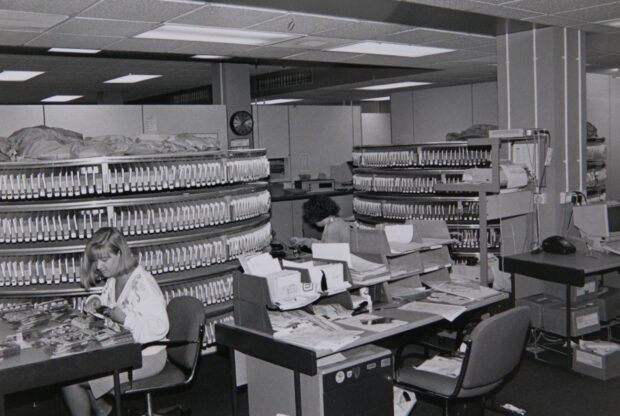
Once all the required information was gathered and handwritten onto a full search or other pre-printed template, it was then taken back to our offices in Lincoln’s Inn Fields and typed onto a report sheet. The report was then generally posted or delivered to clients. The reports were typed either by using a manual typewriter or a state-of-the-art golf ball typewriter. For those of you who are not old enough to remember, this was a typewriter that featured a spherical typing element with an interchangeable head, often likened to a golf ball.
In 1976, Companies House relocated its headquarters from London to Cardiff, the same year the then Queen sent her first email on the precursor to the internet, ARPANET, and Apple was founded in the United States by Steve Jobs and Steve Wozniak. Companies House also started microfilming, creating microfiche copies of new paper documents.
The introduction of microfiche revolutionised the corporate services information industry. This meant that
we no longer needed to sit in the Agents’ Room all day and extract information on companies; instead, we could take the microfiche back to the comfort of our offices and type the required information directly onto a full search report sheet, using the microfiche copies of company files. We could also provide copies of documents using a microfiche reader/printer. However, these machines were largely heat-based and often caught on fire. We could also look up numbers from our roll microfiche film, which was updated weekly and viewed through special roll film microfiche readers by scrolling left and right to find the relevant company along with its company number.
______________________________________________________________________________________________________________________________________________________________________________________
Part 2 will be available in June, where Sam talks about progression during the 1980’s .
If you would like any further information on our services, please contact Alice Spencer on 0161 440 8884 or email [email protected]