
In this three-part series of articles Sam Lloyd, Executive Director of CRO Corporate Services Limited, outlines the evolution of corporate information service provision during his career, including significant events, personal achievements and the influences that have shaped the industry.
PROGRESSION DURING THE 1980S
In 1980, the Companies Act 1980 was introduced. During the same year, Tim Berners-Lee began working on ENQUIRE, the system that would eventually lead to the creation of the World Wide Web, something many of us are fond of now. In 1981, another Companies Act was introduced (Companies Act 1981, surprisingly enough).
In 1981, my sister Mary and I decided to go it alone and start our own business, based in Cardiff. This was a strategic move, given that Companies House was then headquartered in Cardiff, and, of course, the fact that Cardiff was a far cheaper place to set up a business than London.
We purchased an existing tiny micro business from a gentleman, whose solicitor son had set him up with a few small law firm clients to carry out company searches. We paid the princely sum of £1000 for the business, which was called Severnside Searches. We immediately changed the name to Severnside Company Services to reflect that we not only provided UK company searches but also offered a range of company formation and secretarial compliance services.
The corporate searches we provided at this time were essentially for companies registered in England and Wales. However, we would sometimes be asked to provide searches on Scottish and Northern Ireland companies, whose files were kept, at this time, in their respective registries. We also conducted a few searches in offshore jurisdictions, such as Jersey and Guernsey, primarily through an agent.
The business continued to tick along for the next few years. However, I was still relatively young and missed the bright lights of London, so in 1984 I decided to sell my share in the business and move back to London. My sister Mary continued for a few years after I left, along with an accountant who had purchased my share of the business. My sister would then go on to sell her share to one of her employees a few years later.
Upon returning to London, I was offered a job as General Manager at my former employer, D&D, which I accepted.
In 1985, Companies House introduced Stem, which was its first computerised information processing system. That year, Vodafone launched the UK’s first mobile phone network.
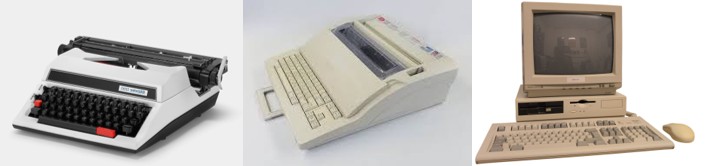
My career was going well working for D&D and I was eventually offered a directorship, which I accepted. During this period, technology was advancing rapidly, and the use of facsimile (fax) to send reports to clients quickly sped up the process, making it the state-of-the-art method for sending reports and documents. However, compared to modern methods of scanning and emailing, it was a protracted exercise, as it could take several minutes for the fax to scan each page.
During my years working at D&D I became the company’s representative for the Law Stationers Association, a trade body that looked after the interests of company search and formation agents. This body then evolved into the European Association of Company Registry Users (EACRU), with David Durham as its Chairman – he had previously served as Companies House’s Registrar of Companies.
EACRU became an essential body during the period, as it opposed several, what we would describe as, madcap changes that Companies House was seeking to impose. One of these changes was to sell its entire microfiche library to a commercial company, which would have left a vast gap in company documents that it could not then provide to the general public. EACRU opposed this vehemently, which culminated in meetings with Ministers, which I attended. The ultimate result of this lobbying was that Companies House eventually dropped the idea of selling the microfiche library, which was a great relief to the corporate information services industry and its clients.
Part 3 will be available in July, where Sam talks about innovation through the 1990s and beyond.
If you would like any further information on our services, please contact Alice Spencer on 0161 440 8884 or email [email protected]